
In the dynamic realm of online customer engagement, companies are increasingly turning to AI technologies, specifically chatbots powered by Large Language Models (LLMs), to revolutionize their website experience. These intelligent chatbots leverage the power of advanced algorithms to understand and respond to user queries, offering a myriad of benefits for businesses looking to enhance customer service, boost sales, and streamline operations.

Let’s see some of the benefits of using AI technology
One of the primary advantages of integrating AI-powered chatbots into your website is the ability to provide fast, 24/7 customer service. These chatbots ensure prompt responses to customer queries, regardless of the time of day, fostering a sense of accessibility and responsiveness. Moreover, AI chatbots excel at offering more personalized experiences. Leveraging LLMs allows these bots to analyze user behaviour and preferences, tailoring responses to create a highly personalized interaction. This not only enhances user satisfaction but also contributes to building a more loyal customer base.
For companies with a global audience, delivering multilingual support is a crucial benefit of AI chatbots. These bots can effortlessly switch between languages, breaking down language barriers and catering to a diverse customer base. Consistency in support is another key advantage. AI chatbots deliver responses with a high level of uniformity, eliminating the risk of human errors and ensuring a consistent quality of customer service across all interactions. The proactive nature of AI chatbots sets them apart. These bots can initiate conversations based on user behaviour, addressing potential issues before they escalate, thereby improving customer satisfaction and reducing the likelihood of negative experiences.
In addition to being proactive, AI chatbots are adept at delivering omnichannel support. Whether a customer interacts through the website, social media, or a messaging app, the chatbot seamlessly integrates across various channels, providing a unified and cohesive customer experience. Furthermore, these chatbots continuously learn and improve with each interaction, contributing to an ongoing enhancement of service quality. They can also collect customer feedback, helping companies gauge customer satisfaction and identify areas for improvement.
By reducing the volume of repetitive queries, AI chatbots free up human agents to focus on more complex tasks, ultimately improving operational efficiency and reducing customer service costs. The ability to detect customer intent adds another layer of context to interactions, ensuring that responses are more relevant and helpful.
Interactive and engaging, AI chatbots boost customer engagement, making interactions more enjoyable for users. Additionally, they streamline service through efficient routing and triage, ensuring that queries are directed to the appropriate departments without unnecessary delays. Beyond customer service, AI chatbots contribute to business growth by boosting sales and increasing lead generation. They assist in product recommendations, guide users through the sales funnel, and capture leads effectively. These chatbots are also valuable tools for A/B testing, allowing companies to experiment with different conversation strategies and optimize user engagement.
And in terms of scalability, AI chatbots shine by serving more customers at scale. Their ability to handle a large volume of simultaneous interactions makes them indispensable for growing businesses looking to expand their online presence.
Like everything else, there are some disadvantages
Despite the numerous advantages, there are challenges associated with AI chatbots. One significant drawback is the bot-to-human handoff process. According to our CX Trends Report, 54 percent of customers expressed frustration with the number of questions they have to answer before being transferred to a human agent. Seamless transitions between chatbots and human agents are crucial to mitigate this frustration.
Another limitation is associated with non-AI chatbots, which rely on scripted dialog and cannot generate responses beyond what has been pre-programmed. This lack of adaptability and flexibility limits their ability to handle complex queries and dynamic interactions.
Additionally, the implementation of AI chatbots can present challenges such as a learning curve, the need for ongoing maintenance, and the requirement for technical expertise. These factors may be barriers for some companies considering the adoption of AI-powered chatbots.
Some examples of what the market offers right now
IBM Watson Assistant:
IBM’s Watson Assistant stands out for its robust AI and Natural Language Understanding (NLU) capabilities. It offers businesses the ability to create highly customized and powerful conversational experiences. However, the complexity of implementation and the need for technical proficiency may pose challenges for some users.

Google’s AI:
Google’s AI is industry-leading, harnessing the vast datasets and natural language understanding capabilities of one of the tech giants. While it provides strong performance, customization options are somewhat limited compared to some other solutions.
Google Cloud Conversational AI Omnichannel Demo
Zendesk:
Zendesk’s chatbot solution offers a balance of user-friendly features and customization options. It provides businesses with the tools to implement efficient chatbot solutions without the complexity associated with some other platforms. However, the extent of customization may not match the capabilities of more advanced AI solutions.

Genesys:
In the domain of contact centre software, Genesys emerges as a powerful solution that seamlessly integrates AI capabilities, transforming customer interactions. Genesys Contact Centre Software offers a comprehensive approach, fusing AI, machine learning, and natural language processing to deliver exceptional service.
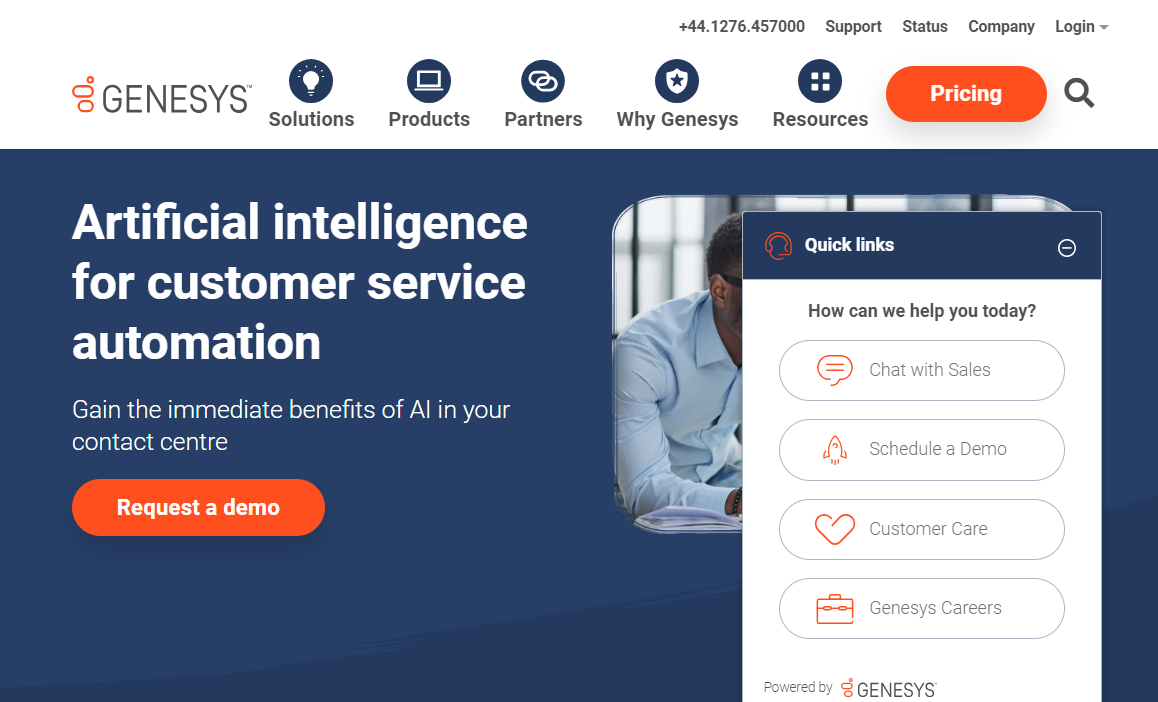
Noteworthy for its multichannel support, the platform unifies communication channels, ensuring a consistent and personalized experience across various touchpoints. Genesys excels in providing intelligent customer support through real-time analytics, enabling proactive issue resolution. Its seamless integration with other business tools and scalability caters to diverse organizational needs. However, users should be mindful of the potential learning curve associated with its extensive feature set, ensuring adequate training and resources for optimal utilization.
Final thoughts
In conclusion, the integration of AI-powered chatbots into your website can bring a myriad of benefits, from enhancing customer service and engagement to boosting sales and streamlining operations. However, it’s essential to be mindful of the potential challenges and carefully choose a solution that aligns with your business objectives and user expectations. As technology continues to advance, AI-powered chatbots will likely play an increasingly integral role in shaping the future of online customer interactions.

 A different view by Jaime Porta
Leave a comment