For the last few years, AI has been sitting comfortably in a very familiar role. It answers questions, drafts emails, summarizes documents, maybe helps your sales team prepare a proposal faster. Useful, sometimes impressive, but still clearly a tool. You ask, it responds. You decide, it executes nothing.
That model has worked well because it is safe.
But the moment AI starts acting on its own, everything changes.
The moment AI stops being a tool
And this is exactly where the conversation is heading now. Companies are no longer asking how AI can support their teams. They are starting to explore how AI can actually do parts of the job. Monitor systems. Update CRM data. Prepare quotes. Trigger workflows. Follow up with customers. All of this without asking for permission every single time.
This is what AI agents bring to the table. But the moment you move in that direction, a much more uncomfortable question appears: Where does the data go, and who is in control?
Because for an AI agent to be useful, it needs access. Access to your CRM, your product data, your documents, your emails, your internal processes. And it needs a certain level of autonomy to act. Not just suggest.
That combination, access plus autonomy, is where most organizations hit the brakes. Not because the technology is not ready. But because the control model is not.
This is the context in which NemoClaw appears. Released in March 2026 by NVIDIA, NemoClaw is an open-source framework that does not try to make AI smarter. It tries to make AI safe enough to actually use. It wraps a governance and security layer around AI agents, defining what they can access, what they can do, and how every action is tracked.
It is still early. Most companies are not deploying fully autonomous agents in production, and NemoClaw itself is still evolving. But that is precisely why it is relevant now. It is one of the first serious attempts to address the real blocker in enterprise AI adoption, not capability, but control. Because the real challenge is not building an agent that can act. It is trusting it to do so.
A realistic use case: Introducing your AI Sales Agent
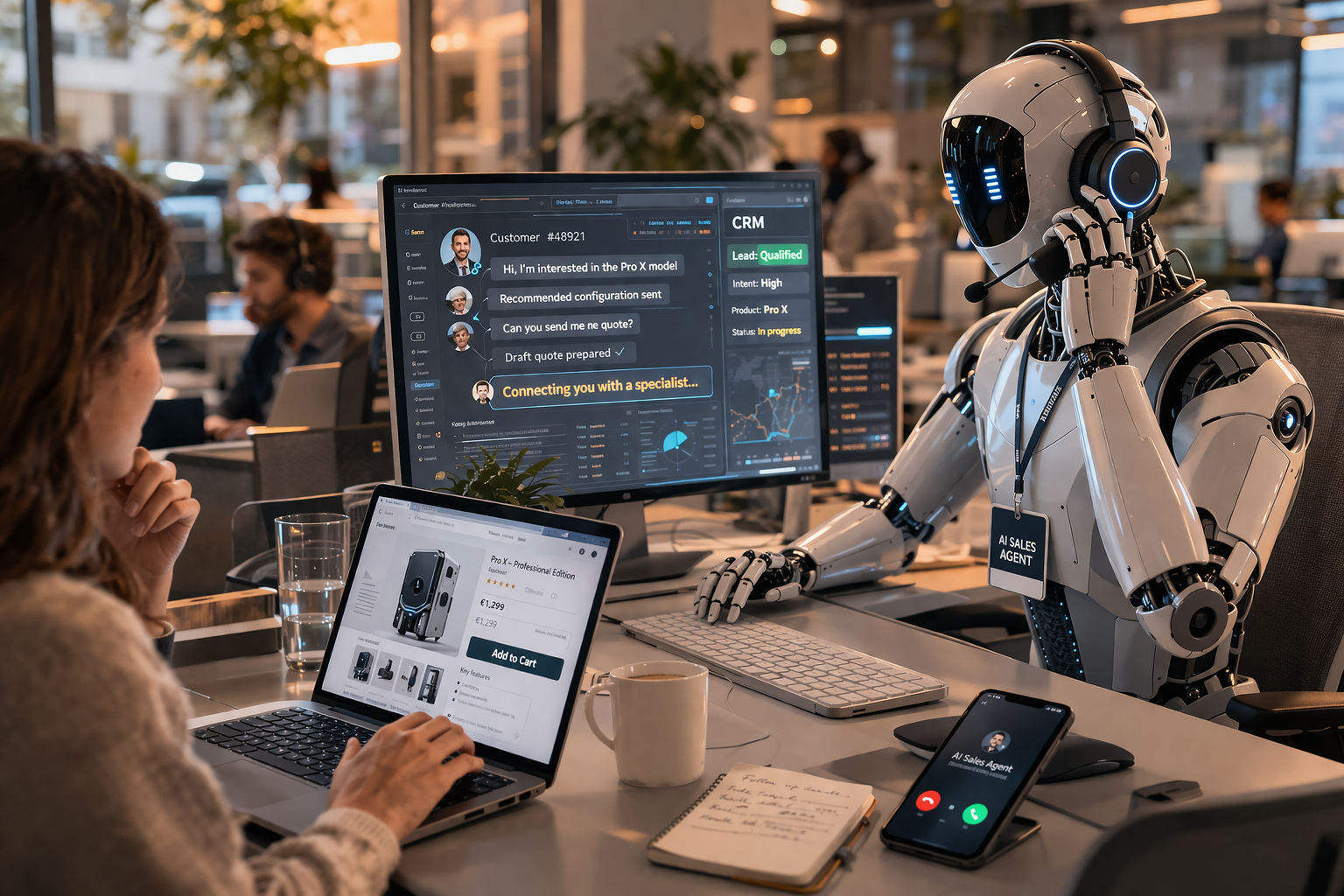
Let’s make this concrete. A customer lands on your website and starts exploring a product. They browse different configurations, compare options, and spend time on key pages. Behind the scenes, the system detects intent signals. This is not just traffic anymore, it is a potential opportunity.
A chat interface appears and offers help. At first, this feels like a standard chatbot. But very quickly, the interaction becomes more dynamic. The AI asks relevant questions, adapts to the context, and starts guiding the customer through the decision. It is no longer answering, it is qualifying.
The conversation evolves naturally:
- What are you trying to achieve?
- What setup do you currently have?
- How soon do you need a solution?
At some point, the customer shows clear intent. Maybe they ask for a quote. Maybe they say they need the product soon. This is where things change. Instead of just capturing a form, the AI agent takes action. It proposes to prepare a tailored recommendation or draft quote. It asks for contact details if needed, or uses existing data if the user is already known. At this moment, the interaction becomes a real commercial opportunity, not just a conversation.
The system detects that this is a high-intent lead and offers: “Would you like to speak with a specialist now?”
This is usually where many digital journeys break. But not here. Behind the scenes, availability is checked. Skills are matched. Priority is evaluated. If a sales representative is available, the call is initiated instantly. The rep joins with full context, including the conversation summary, customer data, and suggested configuration. No repetition. No friction. Just a seamless transition from digital to human interaction.
If no one is available, the AI continues. It schedules a call, logs the opportunity in the CRM, creates follow-up tasks, and prepares everything for the sales team. In both cases, the process moves forward.
Why this was not possible before
If you look at how most companies have used AI until now, the difference becomes clear. Chatbots and copilots have been reactive by design. They respond, but they do not act. They do not update systems, they do not trigger processes, and they do not take decisions beyond the immediate interaction. This has made them easy to adopt, but also limited in impact.
AI agents change that dynamic completely. They are not built to answer, they are built to execute within a goal. They can interact with systems, persist information, and move processes forward. This is where the value is, but also where the risk increases significantly.
Because now the questions are different.
- What data can the agent access?
- What happens if it sends sensitive information to an external model?
- Can it create a quote, or only draft one?
- Who is accountable for its actions?
This is exactly the gap NemoClaw tries to fill. It introduces boundaries where there were none. The agent operates inside a controlled environment. It cannot access systems unless explicitly allowed. It cannot freely send data to external models. Decisions about what stays local and what goes to the cloud are defined upfront. And every action is recorded.
This does not remove complexity, but it makes it visible and manageable. And there are still trade-offs. Local models provide more privacy, but are less powerful. Cloud models offer better performance, but require trust. NemoClaw does not eliminate this tension, it gives companies a way to navigate it.
What companies can actually do today
This is not a future scenario that only large tech companies can explore. The interesting part is how practical this is becoming. Companies can start small, in areas where the balance between value and risk is manageable.
Sales teams can use AI agents to prepare opportunities, enrich leads, and draft follow-ups, reducing manual work without losing control over customer interactions. Support teams can automate the first level of ticket handling while ensuring that sensitive data remains protected. Internal teams can analyze large sets of documents without exposing information outside the organization.
Even personal productivity starts to look different when an assistant is not just helping, but actually organizing and executing tasks within defined limits. The key is not to aim for full automation from day one. It is to define clear boundaries, start with controlled use cases, and build confidence over time.
The shift that matters
For a long time, the dominant model has been simple: have always a human in the loop. AI supports, humans decide, humans execute.
What is emerging now is a different model: Human on the loop.
AI executes within boundaries, humans supervise, guide, and intervene when necessary. This is not about replacing people. It is about changing where human effort is applied. Less time on repetitive coordination, more time on judgment, relationships, and decisions.
NemoClaw is not the end state. But it is a clear signal.
AI is moving from something you use, to something that works on your behalf. And the real challenge for organizations is not whether they adopt it, but whether they can control it when they do.

 A different view by Jaime Porta
Leave a comment