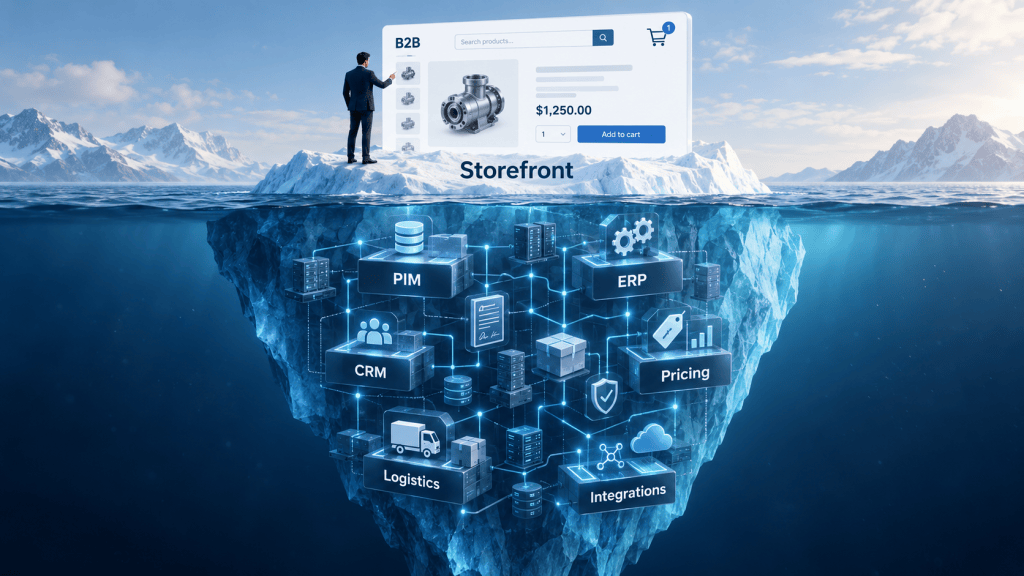
From the outside, eCommerce looks simple. A customer arrives on a website, searches for a product, checks the price, adds it to the cart and places an order. We all do it every week, so it is understandable that companies sometimes look at B2B eCommerce and think: how difficult can this really be?
The answer is usually: much more difficult than it looks. The storefront is the visible part, but it is rarely where most of the work sits. Behind a simple product page there can be product data, customer-specific pricing, availability, contractual conditions, ERP logic, logistics, taxes, compliance rules, payment terms and several integrations. This is why B2B eCommerce is often misunderstood at the beginning. It looks like a digital sales channel, but very quickly it starts touching the way the company actually operates.
The storefront is only the visible layer
Take something as basic as showing a product online. Before the customer can even see it, somebody needs to decide whether that product should be available in that market, whether the description is correct, whether the technical documentation exists, whether the images are approved and whether the content needs to be translated. None of this is particularly exciting from a customer perspective, but all of it has to work before the customer can trust what they see.
Then you get to the price. In B2C, we are used to seeing one price on the screen. In B2B, that answer can depend entirely on who is looking. A customer may have a negotiated price, a distributor agreement, a regional price list, a volume discount or a specific contract. Different countries may work with different rules, some customers may buy directly while others go through distributors, and taxes, currencies and commercial conditions all add their own logic.
Availability adds another layer. Is the product actually in stock? In which warehouse? Can it be sold online? Does it require configuration first? Is there a regulatory restriction in that country? Does it need a quotation instead of a direct order? The customer sees one product page, but internally the company may be resolving dozens of decisions before that page can be trusted.
B2B makes the transaction more complicated than it looks
One thing I have seen repeatedly is that expectations are shaped by B2C. Customers use Amazon, Zalando and other digital services every day, and they naturally expect a similar level of simplicity in business platforms. The challenge is that the transaction itself is often fundamentally more complex.
A B2B customer may represent several entities or purchasing organizations. Different users within the same company may have different permissions. One person selects the products, another approves the purchase, and somebody else receives the invoice. Payment may happen 30 or 60 days later. The customer may expect to see negotiated prices, past orders, technical documents, quotation options or specific purchasing conditions.
And sometimes the customer does not even want to visit your eCommerce platform. Larger organizations may expect your catalog to connect directly to their procurement system. At that point, the project is no longer only about the website. Sales, Marketing, Product Management, Finance, Logistics, Customer Service and IT are all involved, whether the original project plan expected that or not.
Digitalization tends to expose what was already there
This is probably one of the most interesting parts of transformation projects. Technology does not always create complexity. Very often, it simply makes existing complexity impossible to ignore.
Questions start appearing that sound technical at first: Which system owns this information? Where does the correct price come from? Who maintains this field? Why does one country use a different product classification? Why do two teams describe the same process differently? But these are not really software questions. They are questions about process, governance and ownership.
In many organizations, people have been compensating for these gaps for years. A salesperson knows which exception applies to which customer. Someone in Customer Service knows which spreadsheet contains the right information. A local team has developed a workaround that everybody understands, even if nobody ever formally designed it. As long as people are connecting the dots manually, the process can continue.
Automation is less tolerant. At some point, the system needs a rule, and once you ask for that rule, you sometimes discover that there is no single answer. That is when the eCommerce project starts telling you something about the organization itself.
The risk of simply digitizing the current complexity
Once all these exceptions become visible, there is a strong temptation to reproduce them in the new platform. It is understandable. The business already works in a certain way, so the initial reaction is often to make sure the technology supports everything that exists today.

This is where projects can become very expensive. Every local exception, special workflow and historical rule can turn into another requirement. The new platform slowly becomes a digital version of the existing organization, including all the complexity that was already there.
Sometimes that is necessary. Sometimes it is not. A process that required five manual steps yesterday does not suddenly become a good process because those five steps are now automated.
This is where I think eCommerce projects can create value beyond the sales channel itself. They force teams to ask uncomfortable but useful questions: Do we still need this exception? Why is this market different? Does this information really need to exist in three systems? Is this requirement based on customer value, or is it simply the way we have always worked? Those conversations can be difficult, but avoiding them usually means carrying the complexity into the future.
Why companies underestimate the effort
The visible part of eCommerce naturally gets most of the attention. Everybody can look at a webpage and have an opinion about the navigation, search, colors or checkout process. Those things matter because customer experience matters, but the invisible parts are usually less exciting.
Few people get enthusiastic about product-data governance or ERP integration. Unfortunately, those areas often determine whether the customer experience works at all. A good interface cannot compensate for incorrect availability. A strong product page does not help if the technical information is missing. A smooth checkout experience does not matter if the system cannot calculate the correct customer price.
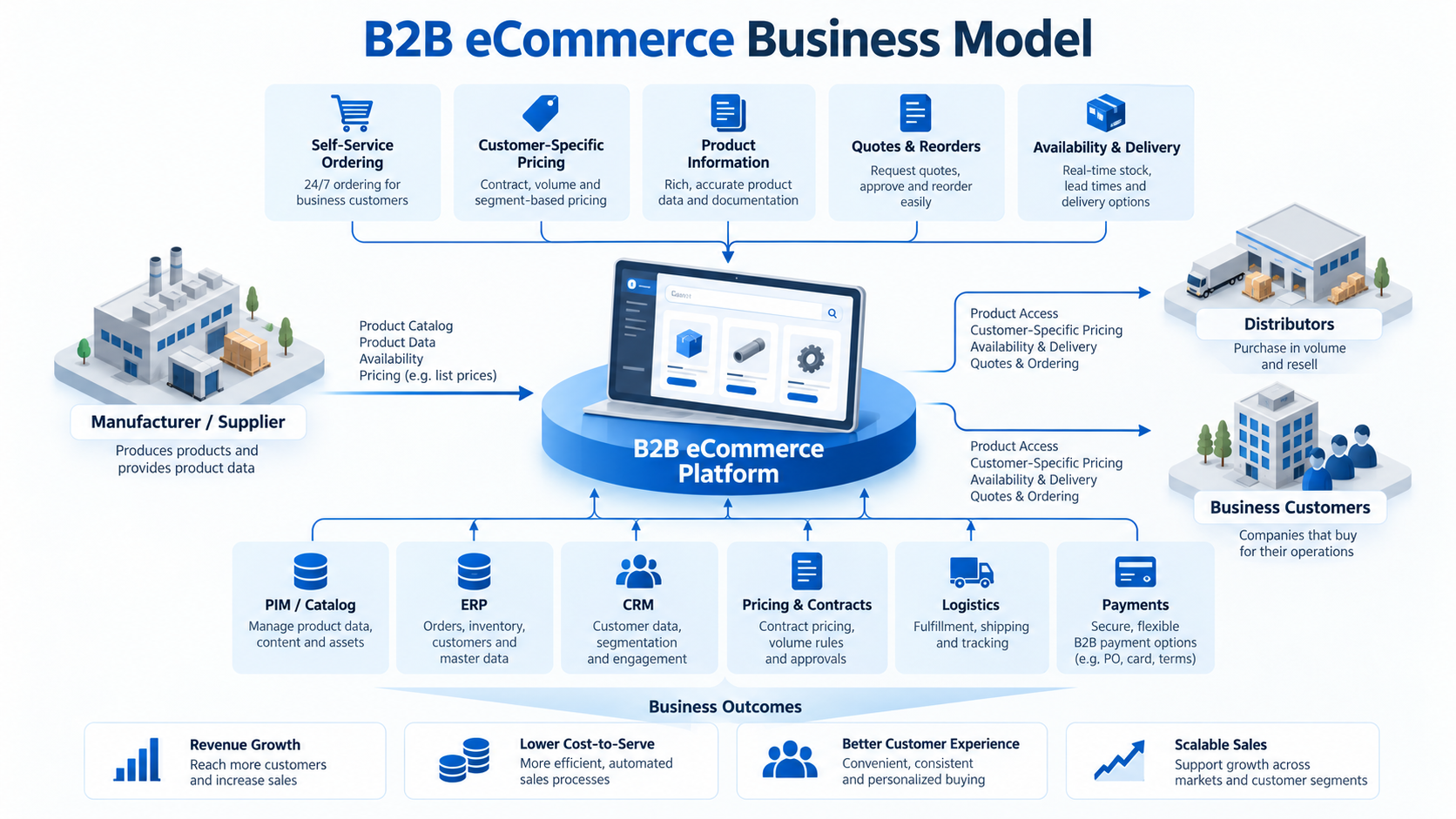
This is also why I am cautious when a transformation discussion starts mainly with platform selection. Of course, technology matters and the right platform matters, but in many B2B projects the harder questions are elsewhere. Do we have the data? Are the processes clear? Who owns the decisions? Can the systems actually provide the information the customer needs? The platform comes into that discussion, but it should not replace it.
Ownership becomes a business question
Another common mistake is trying to place B2B eCommerce neatly inside one function. If Marketing owns it, sooner or later the project needs pricing and ERP decisions. If IT owns it, sooner or later someone needs to make commercial decisions. If Sales owns it, the project still depends on product data, logistics, finance and technical integrations.
There is no clean departmental box for it, and that means governance matters more than many teams initially expect. Someone needs to look across functions and make decisions from the perspective of the customer and the overall business, not only from the perspective of one department. This does not mean every decision needs executive involvement, but it does mean that when functions disagree, there needs to be a clear way to resolve it. Otherwise, the unresolved decisions simply end up inside the technology.
A better question for leadership
When senior management looks at an eCommerce program, the obvious question is often: “When will the webshop be ready?” It is a fair question because it is visible, measurable and easy to put on a roadmap. But it is probably not the most useful one.
A better question is:
What needs to change in our business so that customers can actually buy from us digitally?
That question takes the discussion beyond the website. It brings data, processes, ownership, systems and organizational decisions into the same conversation. And that is why I see B2B eCommerce as much more than a sales-channel project. The shopping cart is only the visible outcome; the real work is creating a business that can serve customers digitally, consistently and at scale.


Leave a comment