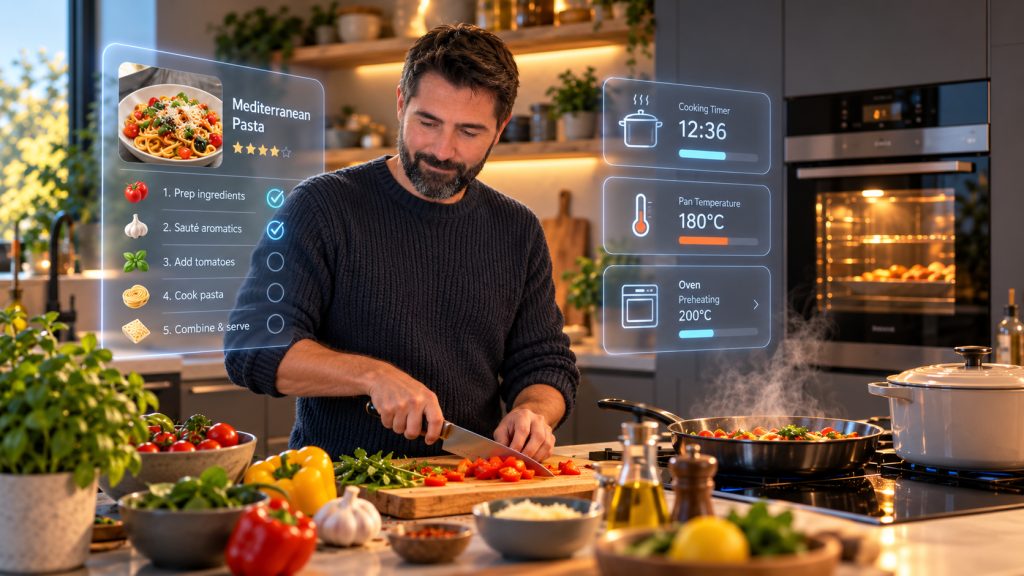
A few days ago, I was preparing salmon for dinner and wanted to get it just right. I was looking for that perfect balance: nicely seared on the outside, but still tender and slightly undercooked in the middle. Instead of searching through cooking websites or watching several YouTube videos, I simply asked ChatGPT how to do it.
It wasn’t the first time. I’ve used AI to adjust recipes, find alternatives when I’m missing ingredients, understand why a sauce isn’t turning out as expected, or figure out the best way to cook a particular cut of meat. Sometimes the recommendations work perfectly. Other times, I need to adjust them based on what I see, taste, or know from experience.
And that got me thinking: What happens when AI stops simply telling us how to cook and starts cooking with us?
We’re already seeing AI change how we work, shop, and access information. But the kitchen might become one of the most interesting places to experience the next stage of this transformation. Not necessarily because we’ll have humanoid robots preparing dinner, but because our everyday appliances could become part of a more intelligent, connected environment.
From Recipes to Conversations
For years, technology in the kitchen has evolved mainly through better appliances. More precise ovens, induction cooktops, multifunctional cooking robots, and devices with increasingly sophisticated programs have made preparing meals easier and more consistent.
Meanwhile, recipes have become digital. We moved from handwritten notebooks and cookbooks to websites, videos, and cooking apps. But the basic process hasn’t changed much: we find a recipe, read the instructions, and try to follow them.
AI is already changing that interaction.
Instead of searching for a specific recipe, we can start a conversation. We can explain what we’d like to eat, which ingredients are available, how much time we have, and even what kitchen equipment we own. AI can then suggest a recipe adapted to those circumstances.
More importantly, we can continue the conversation while cooking. If we don’t have an ingredient, we ask for an alternative. If a sauce becomes too thick, we ask how to fix it. If we’re unsure whether the meat is ready, we can describe what we’re seeing or share a picture.
This is a significant improvement over traditional recipes, but there’s still a limitation: AI provides the instructions, while we remain responsible for interpreting and executing them.
The next step could change that relationship entirely.
When AI Understands What’s Happening in Your Kitchen
Imagine arriving home after work and asking your AI assistant what you could prepare for dinner. It already knows your preferences, the ingredients available in your refrigerator, and which appliances you have at home.
It suggests a couple of options, taking into account the time you have available and perhaps what you’ve eaten during the week. You choose one, and the assistant guides you through the preparation.
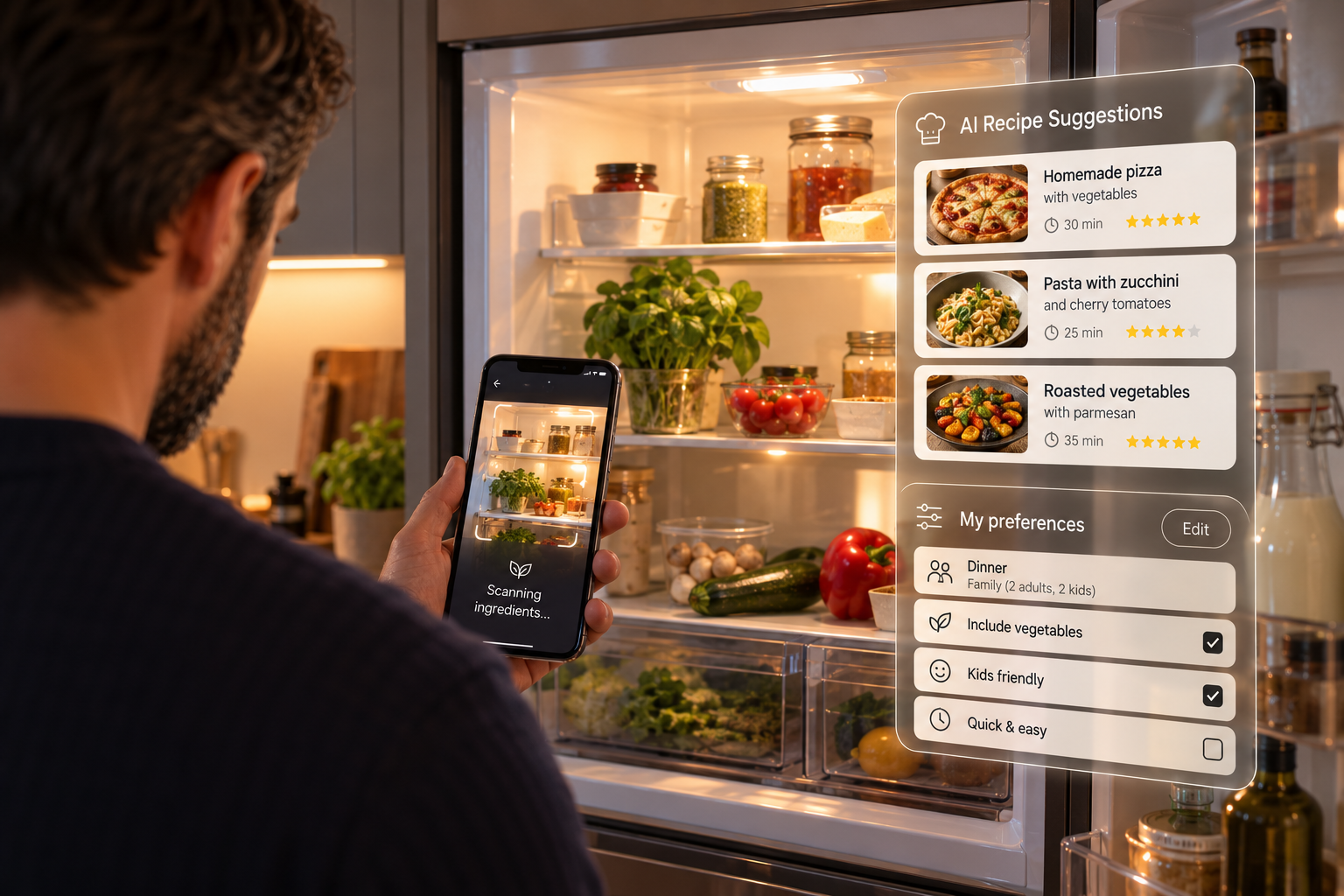
So far, this sounds like an improved version of what we can already do today. But what if the assistant could also see what was happening?
With cameras, connected scales, temperature sensors, and other devices, AI could potentially understand much more about the cooking process. Instead of relying exclusively on the recipe, it could use information from the actual preparation.
Consider something as simple as baking orange muffins. We could ask AI to create a recipe based on the ingredients we have at home. After baking them, we take a picture and explain that they taste good but are slightly dry.
AI could suggest adjusting the amount of liquid, shortening the baking time, or changing the oven temperature. The next time we prepare them, we try those modifications and compare the results.
A photograph alone wouldn’t reliably tell AI exactly why the muffins were dry. But combining what it sees with our feedback, the recipe, and the cooking conditions could make its recommendations more useful.
Over time, an assistant that remembers our preferences and previous results could help us refine recipes according to our own tastes.
This introduces something particularly interesting: cooking becomes a process of continuous improvement, supported by AI. And the same principle could apply to many other everyday activities.
The Next Step: Connecting AI to Kitchen Appliances
This is where things start getting really interesting. Today, we can ask an AI assistant how long to cook a piece of meat or at what temperature to bake bread. But we still need to configure the appliances ourselves, monitor the process, and make adjustments.
Now imagine that the assistant can communicate directly with compatible devices.
Instead of telling us to preheat the oven to 180°C, it could configure the oven automatically, after receiving our approval. A connected thermometer could share the internal temperature of the meat, allowing the assistant to recommend the right moment to remove it. Other appliances could communicate their status, helping coordinate the different steps of a meal.
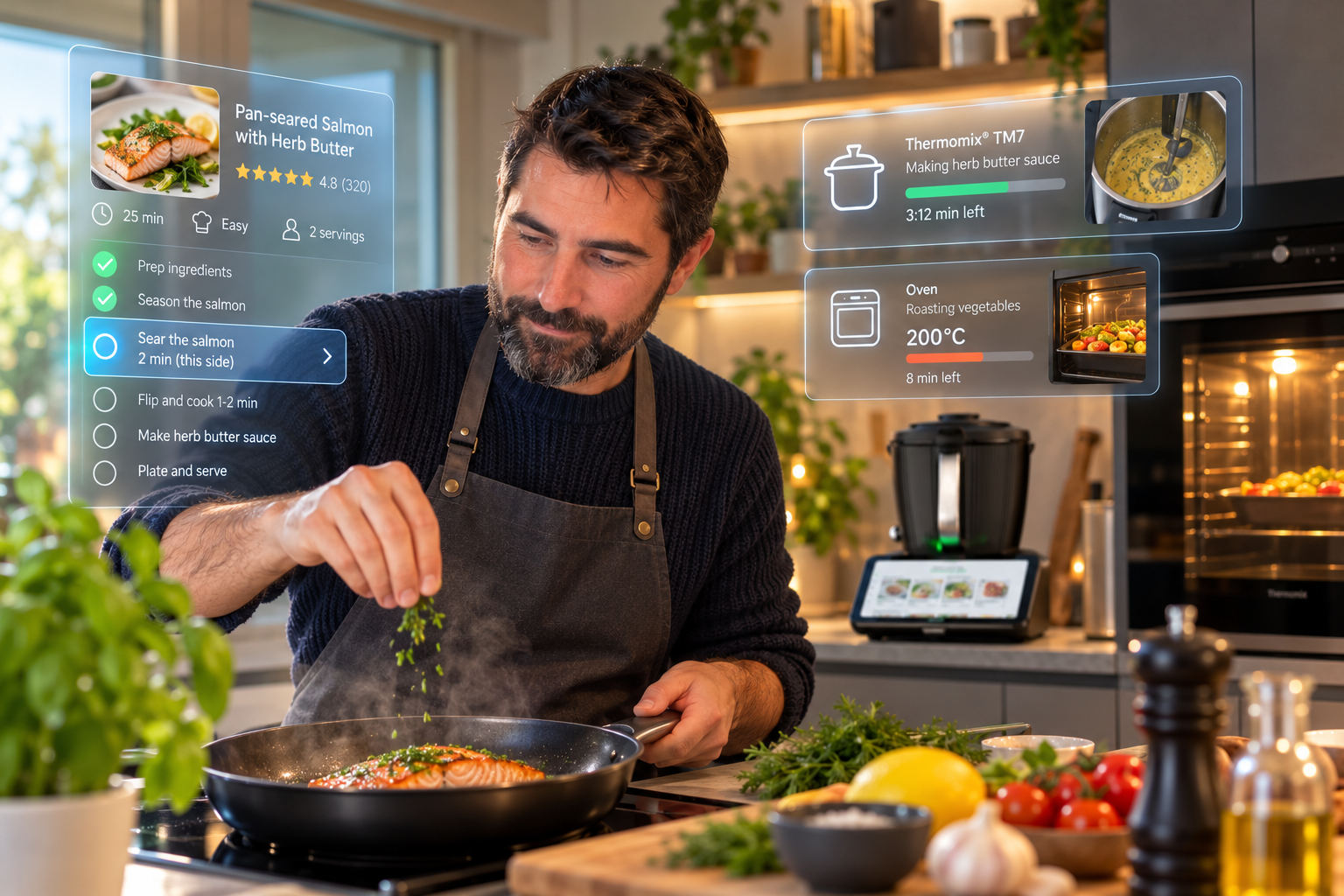
Preparing dinner would no longer involve following isolated instructions. It could become a coordinated process in which the assistant understands the recipe, knows the equipment, and helps manage the timing.
Of course, there are some important challenges.
First, kitchen appliances need to communicate with each other. Manufacturers have traditionally developed their own ecosystems, interfaces, and applications. Connecting devices from different brands remains a challenge, even as smart-home standards and integrations evolve.
Second, there’s the question of safety. Controlling an oven, induction cooktop, or other heating device is very different from switching on a smart light. We need clear permissions, reliable controls, and physical safety mechanisms that don’t depend entirely on an AI model making the right decision.
And finally, the assistant needs to understand what it can and cannot do. An AI that recommends a temperature is not the same as a system authorized to change it.
The technology may make these interactions possible, but trust will determine how much control we’re willing to give it.
Cooking Robots Could Become Much More Interesting
Cooking robots are another fascinating part of this evolution.
Devices such as Thermomix and other multifunctional kitchen appliances have already demonstrated the value of combining different cooking functions in a single machine. Guided recipes can manage mixing, heating, timing, and other operations, making complicated preparations more accessible.
But most of these systems still depend heavily on predefined recipes, supported functions, and programmed instructions.
Imagine combining that functionality with a conversational AI assistant.
Instead of searching through a recipe catalog, we could simply explain what we want to prepare. The assistant could adapt an existing recipe to the ingredients we have, suggest substitutions, and translate the preparation into operations supported by the appliance.
And with the right sensors and control systems, future devices might go further.
For example, when preparing a sauce, the assistant could use temperature and consistency measurements to help determine whether more cooking time is required. When preparing dough, it might recommend adjustments based on measured conditions rather than relying exclusively on a fixed timer.
Some cooking appliances already provide forms of automated temperature control and guided execution. The more ambitious scenario is combining those capabilities with AI that can interpret our requests, adapt the process, and coordinate several devices.
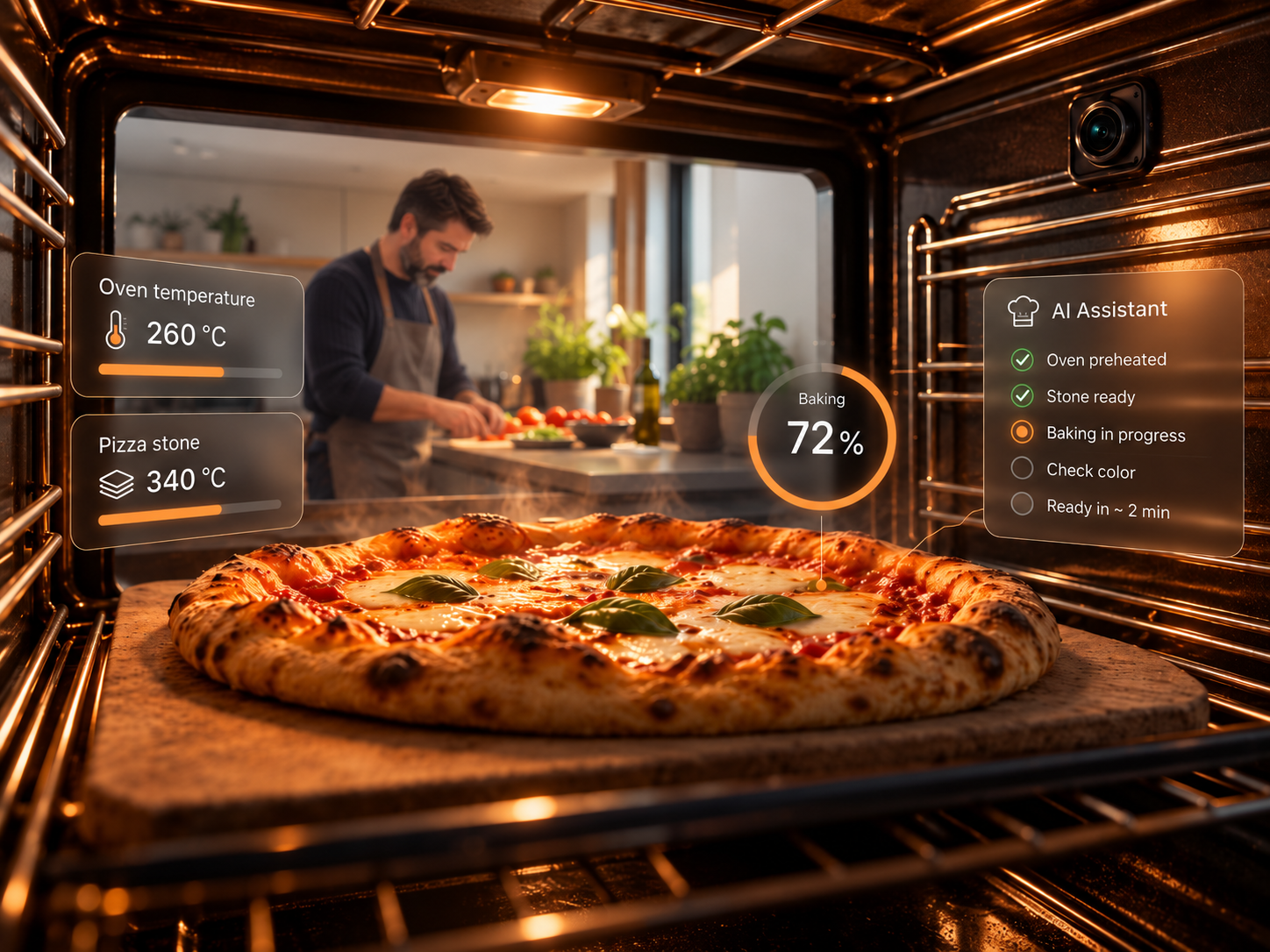
That doesn’t mean giving an AI model unrestricted control of a machine. The actual execution would still need to respect the appliance’s safety limits and validated operating conditions.
But it could fundamentally change how we interact with these devices.
Who Will Own the Kitchen Experience?
There’s also an interesting business question behind all this.
Today, appliance manufacturers generally control the experience through their devices, applications, and recipe ecosystems. Their customers interact directly with the brand when looking for recipes, configuring equipment, or accessing additional services.
But what happens if AI becomes the primary interface?
Imagine asking your preferred AI assistant to prepare dinner without opening the application of your oven, cooking robot, or refrigerator. The assistant understands what you need and coordinates the available devices and services.
Suddenly, the relationship between the customer and the appliance manufacturer starts to change.
Manufacturers could compete not only through the quality of their hardware but also through how easily their products integrate with intelligent assistants. Recipe providers might become sources of content and expertise for those assistants. Grocery retailers could participate by supplying missing ingredients or proposing meals based on available products.
And AI platforms could become an important point of contact between consumers and all these services.
We’ve seen similar questions emerge in eCommerce, where AI shopping agents are beginning to change how customers discover and select products. The kitchen could become another environment where the interface between consumers, products, and services is redefined.
For businesses, the challenge won’t simply be adding AI features to existing appliances. It will be deciding what role they want to play in a connected experience that may extend far beyond their own products.
Will AI Make Us Better Cooks, or Will We Stop Cooking?
There’s one final question that I find particularly interesting.
I enjoy cooking. Not because I’m particularly good at it, but because I like experimenting, trying new recipes, and sometimes improvising based on whatever happens to be in the refrigerator. And I don’t think I would enjoy cooking as much if a machine did absolutely everything for me.
Part of the pleasure comes from the process itself. Choosing the ingredients, adjusting flavors, discovering that something doesn’t work, and finding a way to fix it. Even those occasional failures are part of the experience.
So perhaps the most interesting future isn’t a kitchen where AI replaces us, but one where it helps us become better cooks.
It could make unfamiliar recipes more accessible, help us understand techniques, reduce repetitive tasks, and encourage us to experiment with ingredients we wouldn’t otherwise use. It might also take care of some of the less enjoyable activities, giving us more time for the parts we actually like.
Not everyone will want the same level of automation. Some people may appreciate a fully guided experience, while others will prefer an assistant that offers occasional advice and stays out of the way.
And that’s probably how it should be.
The real opportunity isn’t to remove humans from the kitchen. It’s to make technology adapt to the way each of us wants to cook.
Today, AI can tell us how to cook. Tomorrow, it could become part of the cooking process itself.
And if that means I can finally get my salmon exactly the way I like it, without constantly checking the temperature, I’ll certainly be interested in trying it.


Leave a Reply