
Some years ago, I shared my thoughts on the significance of customer satisfaction and how it shapes our perception of a brand that I want today to retake, after a recent personal experience I had with an online purchase.

A few weeks ago, I made an order for a set of three suitcases from an online store. Excitedly awaiting their arrival, I was disappointed when only one suitcase arrived. Naturally, I reached out to the supplier to address the issue. To their credit, they promptly acknowledged their mistake and offered two choices: cancel the order or receive a complete set in the colors they had chosen, as they did not have available the one I selected my order. I opted for the latter.
Surprisingly, the very next day, a courier arrived to pick up the incorrectly sent suitcase. I appreciated the quick response and effort in handling the return. A few days later, the complete set arrived at my doorstep. However, my surprise knew no bounds when I discovered that they had sent the set in the exact color I had originally ordered, the one they had assured me they didn’t have. It left me pondering whether to recommend this online store to others.
For years, the mantra of “striving for excellence” has driven companies to pursue extraordinary customer experiences. The prevailing belief was that exceeding customer expectations would lead to increased loyalty and bottom-line growth. However, recent research challenges this notion, suggesting that going above and beyond may not always yield the desired results. Back then, in my initial post, I explored the concept of customer loyalty and propose a balanced approach to delivering exceptional service.
Understanding Customer Loyalty
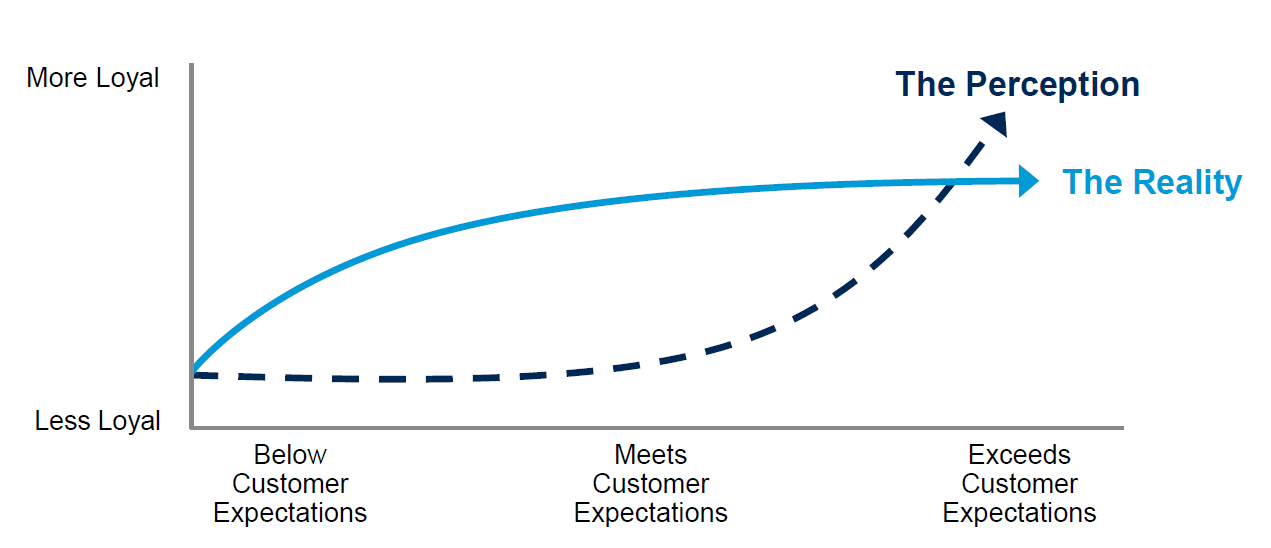
Customer loyalty is undoubtedly crucial for any business’s success. The common assumption has been that exceeding expectations leads to greater loyalty. While customer satisfaction is essential, a Gartner study involving 100 different companies and over 125,000 customers presents a different perspective. It indicates that once expectations are met, any further increase in satisfaction results in only marginal gains in loyalty.
The Fallacy of Over-Exceeding Expectations
Consider the example of offering a complimentary drink upon hotel check-in. While it is a nice gesture, it may not significantly impact the overall perception of the hotel experience, as customers’ main focus is on settling into their rooms and starting their vacations. The study reveals that attempting to exceed expectations excessively can lead to increased operating costs of 10% to 20% without commensurate returns on investment or customer loyalty.
The Power of Creating High Expectations
Rather than focusing solely on exceeding expectations, businesses should aim to create high expectations from the outset. By differentiating themselves from competitors and setting a standard of service excellence, companies can establish a strong foundation for customer loyalty.
But it is essential to strike a balance between meeting customer expectations and providing a memorable experience. Companies should invest in fostering a corporate culture that values excellence and continuous improvement. By ensuring that customers consistently receive what they anticipate, businesses can build trust and reliability.
The Tale of Joshie the Giraffe
A heartwarming story of employees going the extra mile to create a memorable experience for a child and his lost toy illustrates the power of exceptional service. Although such stories are heartening, it is crucial to recognize that they might not guarantee repeat business. Instead, they contribute to the overall positive perception of the brand.

Backing back to my recent experience, and connected with the tail of Joshie the Giraffe, the level of customer satisfaction in this scenario is highly subjective. On one hand, the supplier rectified their mistake promptly and delivered the product as initially ordered. Their handling of the return was swift, and the inconvenience caused was minimal. From this perspective, their efforts were commendable, and it could be argued that my satisfaction should be relatively high.
However, on the other hand, the initial mistake and the conflicting information regarding the color availability left me questioning their reliability and communication. While the issue was resolved satisfactorily in the end, the unnecessary uncertainty could have been avoided with clearer communication from the start.
This brings us to the concept of the “customer effort score” (CES). The CES is a metric used to measure the ease of a customer’s experience in resolving an issue with a company. It takes into account the amount of effort a customer had to put forth to have their problem resolved. In my case, the initial error and the uncertain information contributed to an increased level of effort on my part. However, the swift response and resolution afterward reduced the overall customer effort.
Understanding Customer Effort Score (CES)
A key metric for enhancing customer loyalty is the Customer Effort Score (CES). This score measures the ease with which customers can interact with a brand, from making a purchase to resolving complaints. Focusing on reducing customer effort can have a profound impact on fostering loyalty.

Ultimately, the customer effort score is a valuable tool for businesses to gauge how easy or difficult it is for their customers to interact with their brand. High CES scores indicate that there might be friction in the customer experience, which can negatively impact satisfaction and loyalty.
I think now that it’s clear that how most of the time excellence does not pay off, because once our customers’ expectations were met, increasing their level of satisfaction and loyalty was much more difficult. But what is customer loyalty? We can measure customer loyalty based on several factors, but the main ones are repurchase rate, Share of Wallet (SOW) and Positive Word-of-Mouth (PWoM) o Negative Word of Mouth (NWoM). If you want more information about this topic I invite you to read my post “El Customer Effort Score” (in Spanish).
Once we have seen some of the metrics we can use, we may ask ourselves, but how can I know if my customers are loyal to me? The answer is simple: what do our customers do when something goes wrong? Many companies try to improve customer loyalty with loyalty programs and by trying to improve customer expectations. We talked in the last post that once the customer’s expectations were exceeded, any effort to generate higher levels of satisfaction was not compensated by higher levels of loyalty. The customer was simply already satisfied.
But when things go wrong is when we really check if we have loyal customers or not. Who hasn’t had it happen to you that when your internet is not working properly, you change your provider? Or your phone company? Or your garage? Or your hairdresser? Or your… take your pick?
One way to measure the loyalty of our customers is to measure the effort they have to make to do business with us, especially when things have not gone as planned.
The impact of our customer service department is very high, not when things go well, but when things go wrong and the customer calls us with a problem. And it is logical, it has happened to all of us. If we call to contract a new service, we are quickly put on the phone with a salesperson who solves our need in a few minutes, collects the payment and manages the shipment or activates the service immediately.
The issue changes when we call with a complaint or a problem. Most customers complain that they have to repeat their contact details, or give a new explanation of the problem when they pass the call from department to department; that is when we are not directly attended by a machine offering different options that lead nowhere, or the company’s policies do not allow us to give a solution to the customer. Now a days we have different solutions available to provide a good customer experience when interacting with our Customer Care and it’s easy to share information between your customer care team so the customer doesn’t have to repeat the same information over and over again. A connection with the company CRM is also a must in order to be able to provide the right answers to the customer request.
Poor customer service in these cases can have a very negative impact on customer loyalty. The “customer effort” predicts much better than any other system the future loyalty of your customers. Just ask yourself the following question:
“The company made it easy for me to handle my issue”
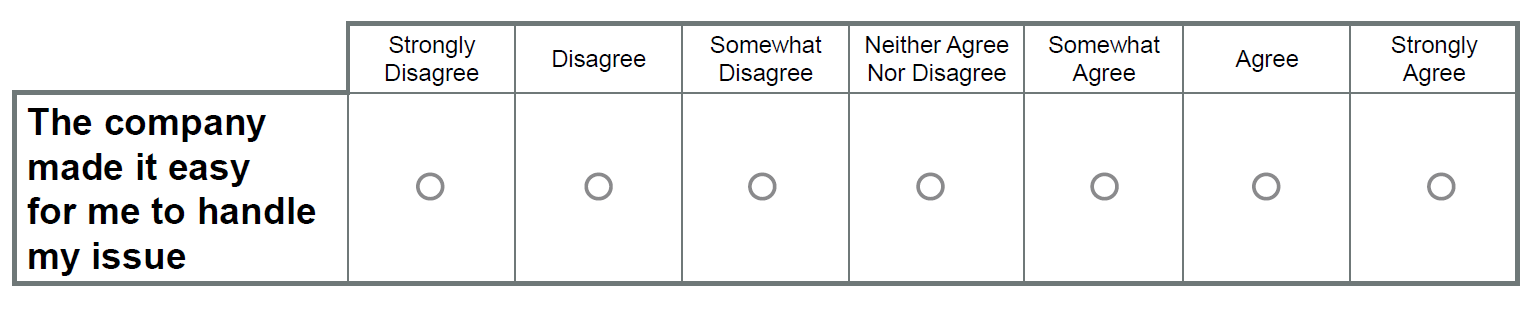
It is not only important to try to make things simple for customers, they must seem simple to them. Effort is 1/3 real and 2/3 perception. So the customer must perceive that it has taken little effort to manage the problem he had. To improve our customers’ perception we can use some tools: take a proactive attitude towards the customer when solving his problem (the customer’s effort can be reduced by 77%), use positive language (reduces effort by 73%), strategically offer a choice between different options to the customer (reduces effort by 55%).
Of course, this implies continuous training of our customer relationship teams and having systems in place that allow us to respond quickly to any problems that may arise. But by applying the “customer effort rate” we can predict much better what the future behavior of our customers will be and it will help us to make better decisions.
In conclusion, my experience with the online store was a mixed bag. While the supplier eventually provided what I had ordered and handled the return efficiently, the initial mistake and conflicting information left room for improvement. As a customer, I appreciate the effort made to correct the situation, but there is also room for the store to enhance communication and prevent such mistakes from occurring in the first place. For example, they didn’t know that the shipment was incomplete even though that it included an invoice a single bag. As for the recommendation, it would depend on the individual’s tolerance for uncertainty and willingness to overlook initial errors in favor of efficient resolution. Each customer’s perspective on satisfaction can be different, and it’s crucial for businesses to continually strive for improvement in their customer interactions.

 A different view by Jaime Porta
Leave a comment